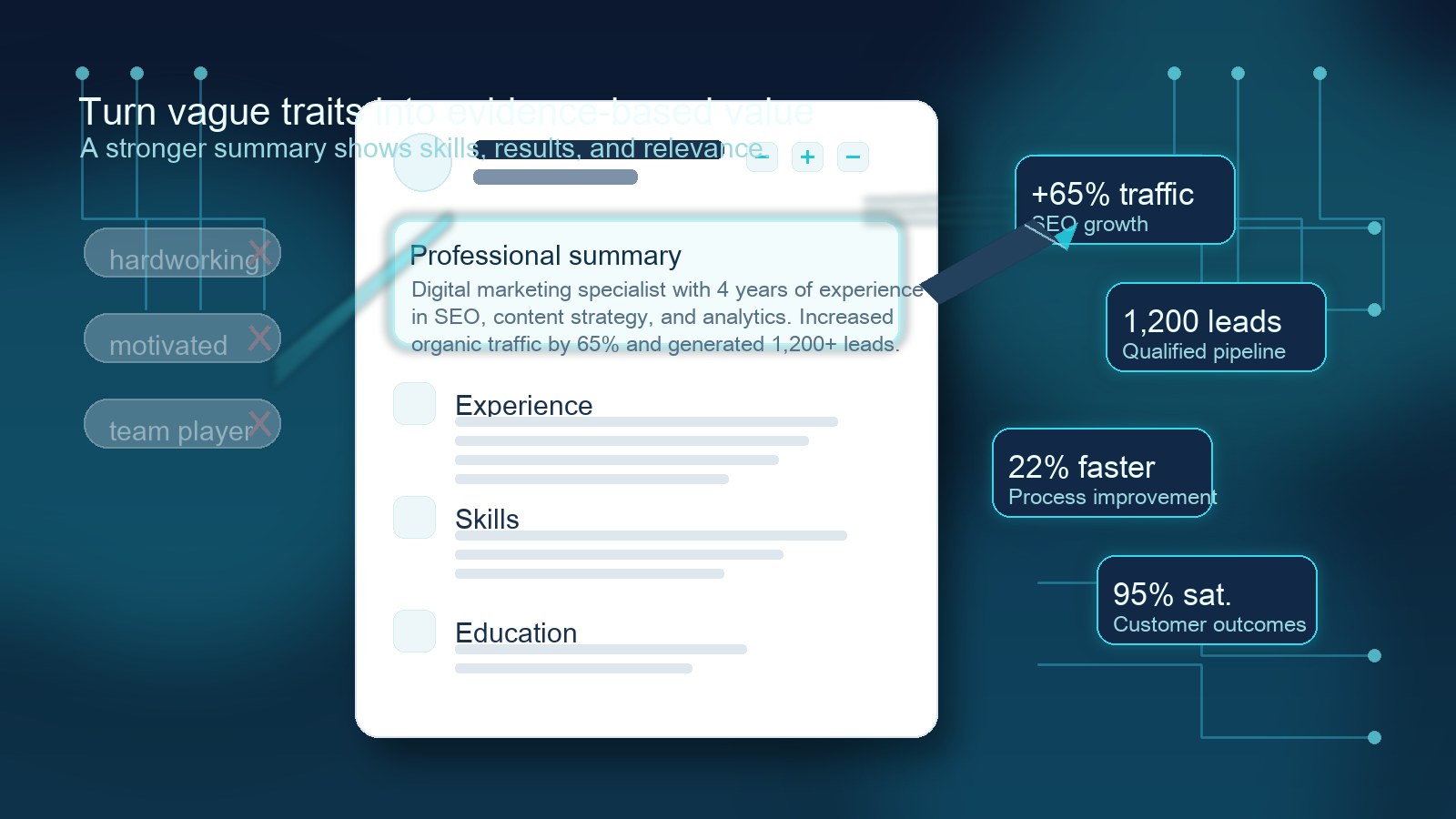
Describing yourself on a resume is less about listing personal qualities and more about showing an employer what you can contribute. A strong introduction quickly communicates your professional identity, relevant skills, experience, and measurable achievements. Harvard recommends keeping resume language specific, active, clear, and fact-based instead of vague or embellished.[1]
When employers ask you to “describe yourself,” they are usually not looking for a personal biography. On a resume, that description typically belongs in a professional summary, profile, or, in some cases, a career objective.
What “describe yourself” means on a resume
Your resume summary should answer three questions:
- Who are you professionally?
- What are your strongest relevant skills or areas of expertise?
- What evidence shows that you can succeed in the role?
A useful formula is:
Professional identity + key skills + relevant experience or achievement + value you can bring
Digital marketing specialist with four years of experience in B2B SaaS. Skilled in SEO, content strategy, and marketing analytics, with a record of increasing organic traffic by 65% and generating more than 1,200 qualified leads through targeted campaigns.
This works because it gives an employer specific information to evaluate rather than simply saying that a candidate is “hardworking” or “motivated.”
Focus on professional strengths
Choose qualities that matter for the position you want. Your description should change depending on the job.
For example, a software developer might emphasize:
- Python and JavaScript development
- software architecture
- problem-solving
- automated testing
- cloud technologies
- project delivery
A customer-service professional might emphasize:
- customer relationship management
- conflict resolution
- communication
- complaint handling
- customer retention
A project manager might emphasize:
- cross-functional leadership
- budgeting
- risk management
- stakeholder communication
- delivering projects on schedule
Harvard recommends tailoring your resume to the position and emphasizing the skills and impact that the employer values most.[1]
Use evidence instead of empty adjectives
One of the most common mistakes is describing yourself with adjectives that do not show what you actually accomplished.
Empty adjectives
- Hardworking, motivated, creative, reliable, and excellent at working with people
- Generic traits that almost any applicant could claim
- No role, no context, and no evidence
Quantified summary
- Marketing coordinator with three years of experience managing social media and email campaigns
- Increased email click-through rates by 28% and helped grow LinkedIn engagement by 45% within one year
- Gives the employer concrete proof of impact
Specific, quantified accomplishments are usually more persuasive than generic claims because they show what your strengths look like in practice.[1][3]
Good and bad resume descriptions
Recent graduate
I am a hardworking and enthusiastic recent graduate looking for an opportunity to develop my skills and gain experience.
Recent business administration graduate with internship experience in market research, customer analysis, and Excel reporting. Conducted competitor research for a 12-company market study and presented findings to senior management.
The stronger version gives the reader something concrete to evaluate.
Experienced professional
Experienced manager with excellent leadership skills and a proven track record of success.
Operations manager with eight years of experience leading teams of up to 35 employees. Reduced processing time by 22% through workflow redesign while maintaining a 98% on-time delivery rate.
The better version replaces generic praise with scope, responsibility, and measurable results.
Career changer
Passionate professional looking to make a career change into technology.
Project coordinator transitioning into software development, with hands-on experience building Python applications and automating reporting workflows. Completed three software projects and developed an automated reporting tool that reduced a weekly manual process from four hours to 30 minutes.
You do not need to hide a career change. Instead, connect your previous experience to the skills required for the role you want.
Customer service
Friendly, positive person who enjoys helping customers and works well under pressure.
Customer service specialist with five years of experience handling high-volume customer inquiries across phone, email, and live chat. Maintained a 95% customer satisfaction score while resolving an average of 60 cases per day.
The stronger version shows what “good customer service” actually looks like.
Avoid overused phrases
Some descriptions appear frequently on resumes but communicate very little on their own:
- “Hardworking professional”
- “Team player”
- “Results-driven”
- “Highly motivated”
- “Excellent communicator”
- “Proven track record”
- “Go-getter”
- “Passionate professional”
You can still use a quality such as “collaborative” or “results-oriented,” but it becomes much stronger when supported by evidence.[1]
Overused phrase
- Results-driven team player with excellent communication skills
- Sounds positive, but says little about the work itself
Evidence-backed rewrite
- Cross-functional project coordinator who led a six-person team through a product launch delivered two weeks ahead of schedule
- Shows communication, teamwork, and results through a concrete example
Should you write “I” on a resume?
Usually, no. Resume summaries are typically written without first-person pronouns.
I am an experienced financial analyst with strong Excel skills. I have improved reporting processes for several departments.
Financial analyst with five years of experience in financial modeling and reporting. Improved monthly reporting processes across four departments, reducing preparation time by 30%.
Indeed recommends a concise summary near the top of the page, focused on relevant experience, skills, and achievements rather than personal phrasing.[3]
How long should your description be?
Keep the description short enough to scan quickly. A professional summary is usually a brief paragraph of two to four sentences, not a long introduction.[2][3]
As a practical rule, lead with the information that best supports your candidacy: your role, your strongest relevant skills, and one or two outcomes that prove you can deliver.
A simple template you can use
You can build your own description with this structure:
[Job title or professional identity] with [number] years of experience in [industry or specialization]. Skilled in [2-4 relevant skills], with experience [specific responsibility or achievement]. [Quantified result or notable accomplishment].
Graphic designer with six years of experience creating digital campaigns and brand materials for technology companies. Skilled in Adobe Creative Suite, UX design, and visual branding. Created campaigns that increased landing-page conversion rates by 18% and supported the launch of three new products.
Recent computer science graduate with hands-on experience in Python, SQL, and web development through academic and personal projects. Built a web-based inventory application and automated data-processing tasks using Python. Seeking a junior software development role where strong analytical and programming skills can contribute to practical products.
The key principle
The best way to describe yourself on a resume is to show, not merely tell.
Instead of:
- “I am an excellent leader.”
- “I have excellent communication skills.”
- “I am organized.”
Show it with evidence:
- “Led a 10-person team through a process redesign that reduced operating costs by 15%.”
- “Presented quarterly performance findings to senior leadership and translated complex financial data into actionable recommendations.”
- “Managed 40+ concurrent client accounts while maintaining 99% on-time delivery.”
Quick tips
- Tailor your description to the role instead of reusing the same line everywhere.
- Put the most relevant hard skills and keywords near the top.
- Replace broad adjectives with scope, metrics, or named achievements.
- Keep your summary concise and easy to scan.
- Support soft skills by showing where you used them successfully.
Your resume is not a biography. It is a concise case for why you are relevant to a specific role. When you’re ready to refine the rest of the document, see how to write a resume in 2026 and technical skills on a resume. CVmotive can help you turn that stronger summary into a polished, targeted resume for each application.