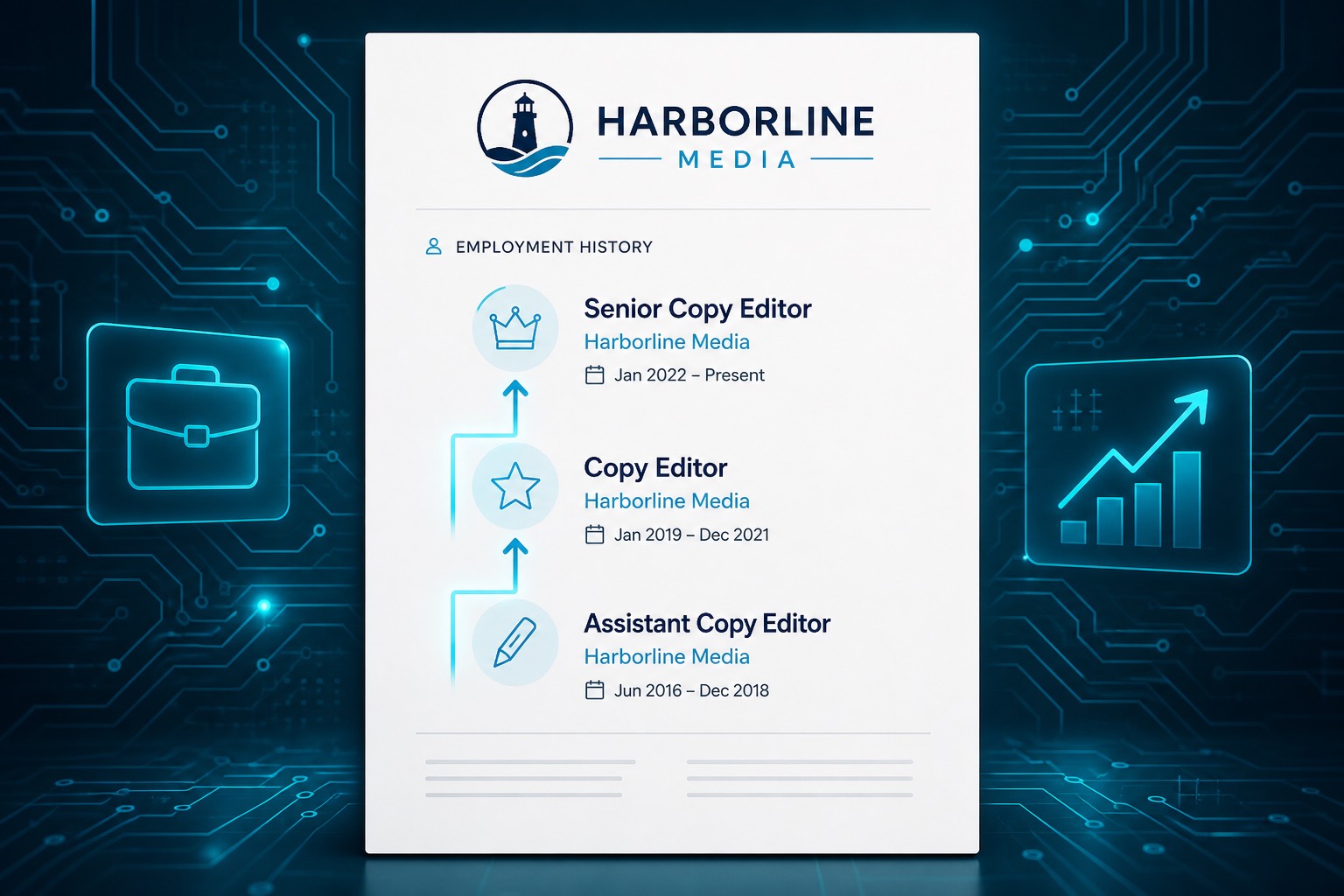
Holding multiple titles at the same company can be a strong part of your career story. It can show progression, growing responsibility, and the ability to take on new challenges without requiring you to repeat the same employer several times.
The challenge is presenting that progression clearly. If every title gets its own company heading, your resume can become repetitive. If you combine roles that were substantially different, you risk hiding important experience.
The best approach depends on how much the work changed.
Stack similar roles; separate substantially different ones
A simple rule is:
- Stack titles when the work remained broadly similar and the promotion mainly reflected greater responsibility, seniority, or scope.
- Separate roles under one company heading when your responsibilities, function, team, or strategic focus changed significantly.
- Use separate company entries if you left the organization and later returned, because the two periods of employment are no longer one continuous stint.[1][2]
One company heading
Harborline Media — Austin, TX Senior Copy Editor | 2023–Present Copy Editor | 2021–2023
- Promoted after reducing revision cycles by 25%
- One employer, clear progression, easy to scan
Every title as a separate employer
Harborline Media — Austin, TX Senior Copy Editor | 2023–Present
Harborline Media — Austin, TX Copy Editor | 2021–2023
- Same company repeated twice
- Tenure fragmented; wastes space
Why multiple roles at one company can help
A promotion or internal move can demonstrate that your employer trusted you with increasing responsibility. It can also show that you built knowledge of the business and were able to apply that experience in a more senior or different role.
That progression is worth making visible.
Rather than making a reader reconstruct your career from several identical company headings, use the layout to tell the story:
Company → earlier role → promotion or move → increased scope → measurable results
Career progression can be particularly valuable when the next role you want is more senior than your previous position. Your resume should make the evidence for that progression easy to find.
Option 1: Stack similar titles under one company
Use a stacked format when your responsibilities stayed substantially the same.
For example, an editor who moved from Copy Editor to Senior Copy Editor may not need separate sets of bullets if the core work remained editing, quality control, and managing the publication process.
Stacked format example
Harborline Media — Austin, TX Senior Copy Editor | 2023–Present Copy Editor | 2021–2023
- Promoted to Senior Copy Editor after reducing average revision cycles by 25%.
- Caught 97% of identified style issues before publication through improved editorial QA processes.
- Coached 20+ freelance writers and editors, improving brief turnaround and reducing avoidable revisions.
- Standardized editorial guidelines across three content teams.
This format keeps the employer and overall tenure together while making the promotion immediately visible. Indeed recommends this kind of stacked approach when positions have similar duties, with the roles listed in reverse chronological order.[1]
When stacking works best
Stack titles when:
- The job function stayed largely the same.
- The promotion primarily represented greater seniority or responsibility.
- Your achievements overlap both positions.
- Combining the roles saves space without making the timeline confusing.
You do not need to force every accomplishment into a specific title. If an achievement genuinely spans both roles, it can sit under the combined entry.
Option 2: Separate substantially different roles under one company
Use separate entries when the nature of the work changed enough that each role tells a different story.
For example, moving from Content Associate to Product Marketing Manager involves a significant change in responsibilities. The earlier role might demonstrate content production and editorial skills, while the later role demonstrates positioning, launches, research, and go-to-market strategy.
Separate roles example
Northglass Labs — Denver, CO Product Marketing Manager | 2022–Present
- Promoted from Content Associate to lead product marketing after demonstrating ownership of cross-functional launches.
- Developed launch messaging that contributed to an 18% increase in trial starts.
- Partnered with Product, Sales, and Customer Success to reposition three core product offerings.
- Built competitive and customer-insight briefs used by sales and product teams.
Content Associate | 2019–2022
- Produced 200+ articles, guides, and customer stories for a growing B2B technology audience.
- Improved on-time content delivery from 86% to 98% by introducing a standardized editorial workflow.
- Collaborated with subject-matter experts to turn complex product information into customer-facing content.
Here, the company appears once, but each role gets its own dates and achievements. That makes it much easier to understand what you did at each stage of your career. Indeed and The Muse both recommend this approach when responsibilities or functions changed substantially.[1][2]
A useful test: would you apply to different jobs?
If you are unsure whether to stack or separate your titles, ask:
Would these two roles qualify me for meaningfully different jobs?
If the answer is yes, give them separate entries.
For example:
- Marketing Coordinator → Marketing Manager: potentially stackable if the work remained similar.
- Marketing Coordinator → Product Manager: probably separate.
- Software Engineer → Engineering Manager: separate.
- Junior Designer → Senior Designer: often stackable if the underlying design work remained similar.
- Sales Representative → Customer Success Manager: separate.
This isn’t a rigid rule. The amount of space available and the job you’re targeting also matter. But it is a useful way to decide whether combining roles would hide relevant experience.
Make the promotion obvious
Don’t make recruiters hunt for evidence that you were promoted.
A short bullet under the newer role can explain what happened and, ideally, why:
- Promoted to Senior Account Manager within 12 months after exceeding client-retention and revenue targets.
That is more informative than simply listing:
Senior Account Manager | 2023–Present
The Muse specifically recommends making the promotion explicit, particularly when titles are stacked, so a reader can understand the relationship between the roles and the accomplishments listed beneath them.[2]
When possible, connect the promotion to a measurable result:
- Promoted after increasing customer retention by 14%.
- Promoted to team lead after reducing processing time by 30%.
- Promoted within 18 months after exceeding annual sales targets by 22%.
- Selected to lead a 12-person team after successfully delivering three major launches.
The exact reason for a promotion won’t always be measurable, of course. If there isn’t a meaningful metric, explain the increased scope instead.
Keep the timeline easy to scan
Whichever format you use, list roles in reverse chronological order, with your current or most recent position first.[1]
For example:
Company Name — Location
Senior Manager | 2024–Present Manager | 2021–2024 Associate | 2019–2021
This lets a reader understand your progression without having to reconstruct the timeline.
Use consistent date formatting throughout the resume. For example, choose either:
- Jan 2024 – Present
- January 2024 – Present
- 2024 – Present
and use the same style everywhere.
Be careful with stacked titles and ATS software
Stacking similar roles saves space, but it can introduce one potential drawback: applicant tracking systems (ATS) may not always associate a shared group of bullets with the correct title.
The Muse notes that an ATS could potentially attribute combined bullets to the wrong position when titles are stacked.[2]
If ATS compatibility is a concern, separating titles and their bullets can make the relationship between a role and its accomplishments more explicit.
That doesn’t mean you should avoid stacking altogether. It means you should choose the format based on the complexity of your career history.
Don’t duplicate the same achievement
One of the biggest mistakes when listing multiple roles is repeating the same accomplishments under every title.
If you managed the same editorial process for three years, don’t describe that process three times just because you received two promotions.
Instead, show how your contribution evolved.
Repeated identical bullets
Senior Editor
- Edited articles.
- Managed editorial workflow.
Editor
- Edited articles.
- Managed editorial workflow.
Progression across roles
Senior Editor
- Led a six-person editorial team and reduced publication turnaround by 25%.
- Introduced a quality-control process that reduced post-publication corrections by 40%.
Editor
- Edited 150+ articles annually and developed the workflow later adopted by the wider editorial team.
The second version shows progression rather than repetition.
Use your strongest evidence where it matters most
Your most recent role usually deserves the most attention, particularly when it is relevant to the job you’re applying for.
Older roles can be shorter. You don’t need to give a five-year-old position the same number of bullets as your current one if the earlier work is less relevant.
Focus bullets on:
- Results
- Scale
- Scope
- Leadership
- Revenue or cost impact
- Efficiency improvements
- Relevant projects
- Skills that match the target role
Quantified achievements are especially useful because they give the reader evidence of impact rather than simply describing responsibilities.
For example:
Less effective: Responsible for improving customer onboarding.
Stronger: Redesigned customer onboarding, reducing average time to activation by 21%.
Watch your verb tense
For your current role, use present tense for ongoing responsibilities and achievements:
- Lead a team of eight.
- Manage a $2M annual budget.
- Develop product launch strategies.
For previous roles, use past tense:
- Led a team of eight.
- Managed a $2M annual budget.
- Developed product launch strategies.
If you were promoted within the same company, this distinction can help make the timeline easier to follow.
What if you left and later returned?
If you worked for another organization and subsequently returned to your original employer, treat those as separate periods of employment.
For example:
Harborline Media — Austin, TX Senior Copy Editor | 2025–Present
Other Company — Austin, TX Content Editor | 2023–2025
Harborline Media — Austin, TX Copy Editor | 2021–2023
In this situation, repeating the company name is useful because it makes the gap and return immediately clear. Indeed recommends separate entries when employment with the same company was interrupted.[1]
Common mistakes that hide career progression
- Listing every title as a separate employer — This can make a long tenure look fragmented and wastes valuable space.
- Combining roles that were actually different — If you moved from engineering to management, or from content to product marketing, combining the roles can hide important experience.
- Burying the promotion — If you were promoted, say so. Don’t assume the reader will infer it from two titles and a date range.
- Repeating identical bullets — Your resume should show how your responsibilities and impact evolved, not repeat the same description for every title.
- Listing older roles first — Reverse chronological order makes progression much easier to scan.[1]
- Using vague claims — “Helped improve performance” tells the reader very little. Whenever possible, explain what changed and quantify the result.
- Letting your resume get out of sync — After an internal promotion, update your resume, LinkedIn profile, portfolio, and other professional materials so your current title and dates are consistent.
Quick decision guide
- Same function, higher title — Stack titles
- Similar responsibilities, broader scope — Usually stack
- Different department or function — Separate roles under one company
- Major change in responsibilities — Separate roles under one company
- Individual contributor → manager — Usually separate
- Left company and later returned — Separate company entries
- Same achievements apply across both roles — Stack and use shared bullets
- Each role has distinct achievements — Separate bullets for each role
The goal: make progression obvious
Your resume should not force a recruiter to decode your career history.[3]
If your work stayed broadly the same as you moved up, stack the titles and use a concise set of high-impact bullets.
If your responsibilities changed substantially, separate the roles under one company heading and give each position its own achievements.
Either way, make the progression unmistakable: show the dates, put the newest role first, explain the promotion or internal move, and use measurable results wherever possible. That turns several titles at one company from a confusing timeline into evidence of career growth.
When you’re ready to update the resume, use CVmotive to build a clean, polished version that keeps your experience easy to scan.